Back to Blog
 Jen Dawson
Jan 2026
5 min read
Jen Dawson
Jan 2026
5 min read
Why AWS Marketplace GTM Fails for Most SaaS Companies (And What the Winners Do Differently)
Jen Dawson
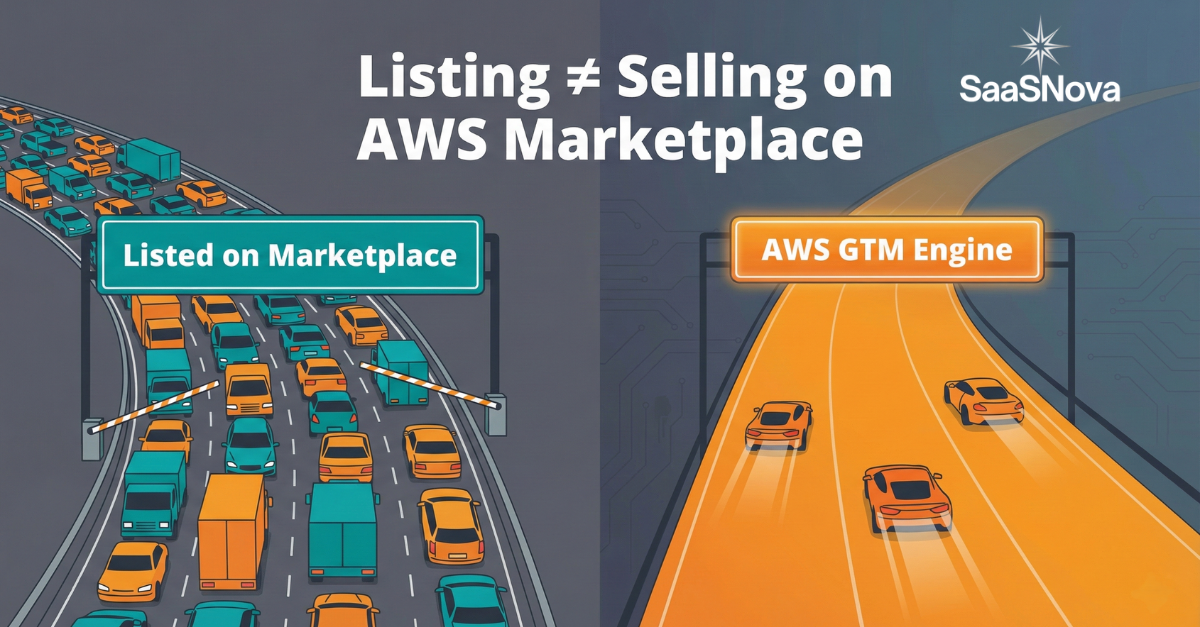
Six months after launch, most SaaS companies have the same Amazon Web Services (AWS) Marketplace result: zero pipeline.
The listing is live. The celebration happened. The "strategic partnership" was announced on LinkedIn.
And then Nothing.
No AWS-sourced deals. Sales teams calling it "too complex." Finance buried in spreadsheets trying to match disbursements to actual customers.
This isn't an AWS problem. It's an execution problem.
You treated a go-to-market system like a launch project.
I've watched this pattern repeat across dozens of SaaS teams, from first-time founders to late-stage companies.
High-value B2B deals don't happen through public listings on AWS Marketplace. They happen through Private Offers, custom deals with negotiated pricing built for a specific buyer.
Your listing isn't a lead gen machine. It's a procurement vehicle.
If you're waiting for inbound, you're waiting forever.
They won't.
Selling through AWS Marketplace requires a different motion. Your reps need to know how to register deals in AWS Partner Central, how to articulate why burning cloud commit matters to a CIO, and how to create Private Offers without losing three days to back-and-forth.
Without a playbook, they'll revert to what they know. Which means they'll ignore the Marketplace entirely.
Later never comes.
Manual offer creation feels fine when you're doing two deals a quarter. At ten deals a month, it becomes a bottleneck that kills velocity.
No integrated system means no scale. Operations aren't the cleanup crew. They're the engine.
I've seen this pattern repeat across dozens of ISVs. The failure happens in four places.
Most teams treat readiness like a form to fill out. Tax info, banking details, product page live. Done.
Real readiness means mapping your sales workflows to AWS-native processes. It means getting through the Foundational Technical Review (FTR) so AWS field teams actually trust your product enough to recommend it.
Without FTR, you're invisible to co-sell. With it, you're tagged "Reviewed by AWS", the credibility signal that moves deals forward.
Your product detail page gets treated like a placeholder. Generic copy. No customer proof. No clear connection to how you help AWS customers burn commits faster.
AWS sellers search the Marketplace when they need a solution for an active deal. If your page doesn't immediately signal value and trust, they move on.
A strong listing answers two questions in ten seconds: "What does this do for my customer?" and "Why should I bet my credibility on it?"
Your team treats every AWS Marketplace deal like a science experiment. They don't register opportunities in Partner Central through APN Customer Engagements (ACE). They can't explain how the Marketplace accelerates procurement. Private Offers take a week to create because no one remembers the last time they did one.
This isn't a sales problem. It's a system problem.
Repeatable wins come from repeatable process. You need ACE hygiene, standardized offer workflows, and a narrative that makes AWS field sellers want to help you close.
Deal volume grows. Your backend doesn't.
Offers get tracked in Slack threads. Renewals live in someone's calendar. Finance can't reconcile disbursements because there's no source of truth connecting the CRM to what AWS reports.
Velocity dies in the manual work between systems.
Here's what it looks like in practice.
You launch on AWS Marketplace. Six months have passed. Pipeline is flat. Sales complains the Marketplace "adds friction". Finance is manually matching AWS payouts to contracts they can't find.
Leadership starts questioning the entire strategy.
You have a listing. You don't have a business.
Success on AWS Marketplace isn't accidental. It's built in stages, with each stage matched to where your company is today.
Here's how our programs work.
3 months | For ISVs launching, relaunching, or proving first attributable cloud revenue.
Ideal Stage: Pre-Series A to Series A. For ISVs establishing their first cloud-attributable traction.
4 months | Designed for APAC and EMEA ISVs entering the US market with cloud-attributed revenue goals. For global ISVs entering or expanding in the US market with cloud-validated GTM traction.
Ideal Stage: Series A to Series B. For ISVs proving US traction and cloud-validated revenue, including those operating on one or more clouds.
6 months | For ISVs expanding beyond early traction into repeatable, attributable, multi-cloud revenue. Built for teams ready to operationalize co-sell, scale partner-led pipeline, and mature their cloud GTM engine across AWS, Azure, and GCP.
Ideal Stage: Series A to Series C. For ISVs operating on one or more clouds and expanding into multi-cloud GTM.
When executed correctly, AWS Marketplace delivers three advantages that fundamentally change how you sell:
But none of this happens by default. It requires a system.
That's what SaaSNova builds.
1. What is the difference between listing and selling on AWS Marketplace?
Listing is technical access. Selling requires active co-sell, Private Offers, and operational discipline.
2. How does AWS co-sell work in reality?
Deals are registered in ACE inside Partner Central. AWS AMs reviews them and provide co-sell support through introductions or procurement acceleration.
3. Why are Private Offers critical?
Because most enterprise deals on AWS Marketplace use them. Public pricing rarely closes large contracts.
4. Is the Foundational Technical Review required?
No. But without it, many co-sell paths stay closed. It is a trust signal to AWS sellers.
5. How does billing work?
AWS bills the customer and disburses funds monthly. The complexity lies in tracking, not collecting.
Ask your team:
If you answered "No" to any of these, you don't have a system.
You have a listing that isn't making you money.
The companies winning on AWS Marketplace didn't get there by listing harder. They built execution systems that turn a passive product page into a predictable revenue channel.
Success on AWS Marketplace is not an accident. It's the direct result of a deliberate, execution-first system.
SaaSNova's Ignite, SuperNova, and NovaX programs are that system. They match your stage and install the exact operating model you need to move from stuck to scaling.
That's the difference between a project and a business.
Join the Discussion (0)
Add a Comment